Drangarnir, Faroe Islands
A note on access: This story reflects my experience hiking to Drangarnir in February 2020. Access has since changed. Visitors are now required to join an authorized local guide, and the current official tour runs seasonally. Always confirm current rules, weather conditions and availability before planning your hike.
Pulling into the back parking lot of a seafood wholesaler, Saviour Mifsud cut the engine. We were only ten minutes from Vagar Airport, where less than an hour before I had deplaned from two days of flights across the world. In the gravel parking lot, we popped open the trunk, sitting on the bumper we laced up our hiking boots, sharing the CliffsNotes versions of our lives as an introduction. We pulled on extra layers and checked camera gear. After tossing a few more snacks into my pack, we made our way through the industrial parking lot and crossed through the sheep gates hidden in the back.
Enormous snow-capped mountain ridges sprang up from either side of the wide Fjord. We slipped along slick, excrement-sprinkled, muddy sheep trail. Our trail led along the base of the layered mountain toward the mouth of the bay. The arctic February air and grandiose landscape invigorated me, giving a post-travel boost caffeine never could. As I crossed my third small stream bed, I joked that this was how the hobbits must have felt, tripping through a larger-than-life landscape on the precipice of a grand adventure.
Saviour told me about his life in the Faroes, having moved here from Malta for the love of the landscape and a woman in 2006. Over a decade later things hadn’t quite worked out with the woman, but the craggy archipelago still had him captivated. He had started hiking and guiding nearly every chance he got since 2015 and posting photos of the rugged island nation on his social-media accounts, eventually capturing the attention of local media, airlines, and wanderlust-struck travelers like myself.
We made our way to a small beach, where large pipes entered the ocean, perhaps diverting the fresh water to the circular salmon farms that seemed to line every coastline. The beach was covered with gorgeous seashells… and microplastics, having floated in on the sea from every other corner of the world. I had read somewhere that the small cove had been used to smuggle goods from Denmark to the Faroe Islands. A little, mossy-roofed shed sat above us. Overgrown curly-haired sheep shyly darted from the beach up the hillside with impressive agility.
Saviour’s phone rang, a stark juxtaposition to the quiet isolated surroundings. No matter how remote or far back in time you seem to have travelled on the Faroes, there is always cell service. It was the farmer who owned the land we were hiking, calling us from his home across the water in the town of Bour, a quaint, colorful town with more moss-covered roofs. He had spotted another hiker through the telescope in his living room, and wanted to know if he was a part of our party, if so, we had only paid for two people. Saviour assured him he was not, and the farmer hung up to drive around the harbor and intercept the trespassing hiker at the trailhead.
I had paid 750 Danish Kroner, equivalent to just over 100 USD to hike this trail with a guide. I had never paid for a day hike before. On travel websites and in the living room of my hostel, tourists were livid regarding the hiking fees. How could one charge so much to simply walk? There were no bathrooms installed, no water-fill stations, the trail seemed like it could be maintained by a steady stream of hikers and the sheep that inhabited it. Shouldn’t nature be free?
In an ideal world, yes. However, as tourism booms across the islands it seems more than fair for landowners to capitalize on trespassers, while protecting their fragile backyards. When the concept of Virding, Faroese for “Respect,” is not upheld for the environment by tourists, the cost of hiking the outfields can help with the cost of maintaining them. And at the root of it, perhaps this fee was simply the cost of keeping nature wild.
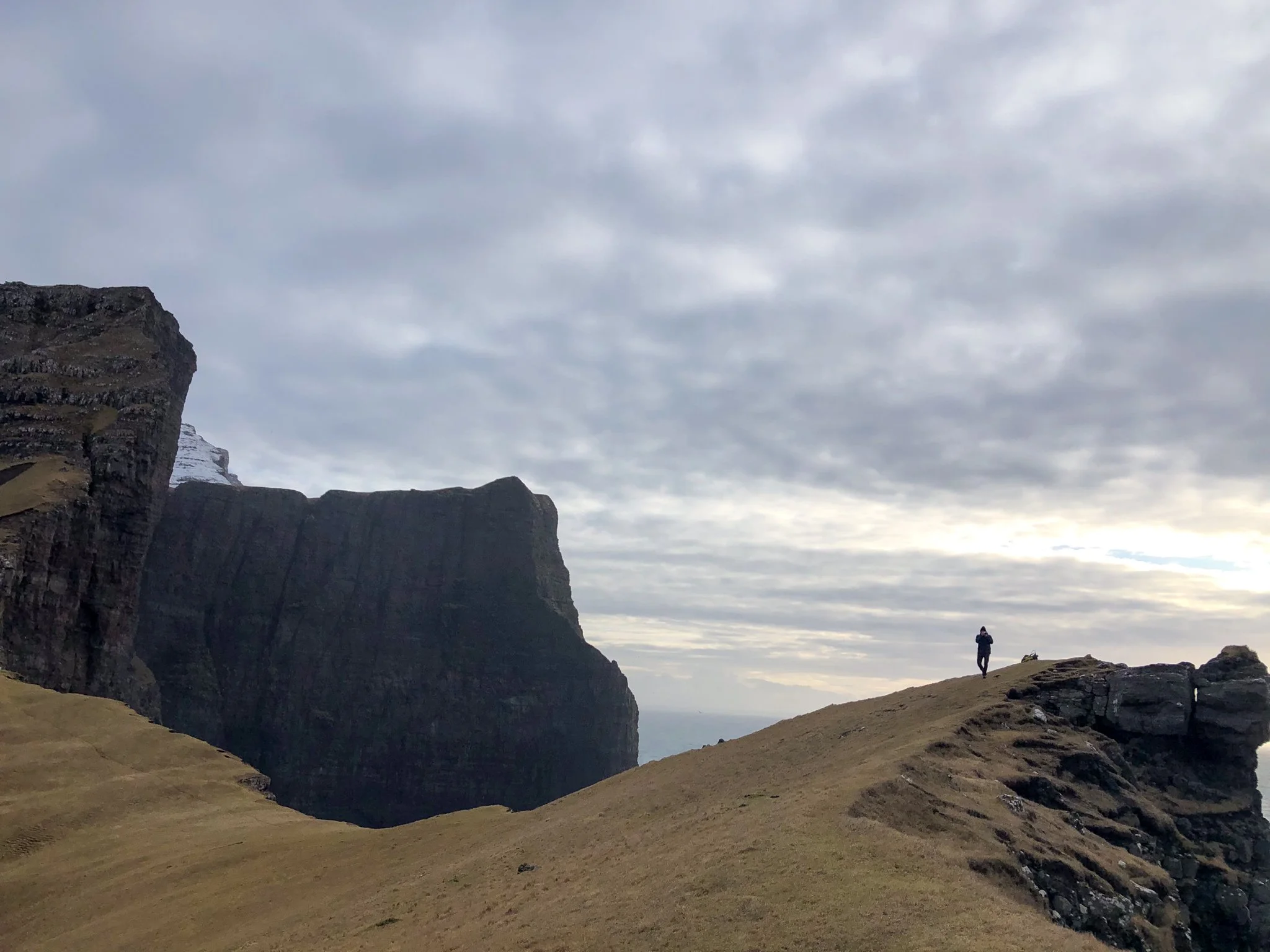
We followed the sheep trails back up the hillside, the edge of the trail quickly dropping off - slipping now would mean an unavoidable tumble into the frigid Atlantic waters. We had been blessed with a sunny, calm day - atypical weather for the notoriously fickle archipelago. I could only imagine this trail would be terrifying in the landlocked fog and rain typically defining a Faroese February.
The trespassing hiker materialized in front of us, zipped up into a rain jacket carrying a backpack filled with camera gear that cost more than my car back home. His wind-bitten pink cheeks and wide smile greeted us. Saviour politely warned him the farmer had spotted him through the telescope, and the young American grinned “Yeah, I’ll pay him when I get there, that was worth every penny. Incredible.”
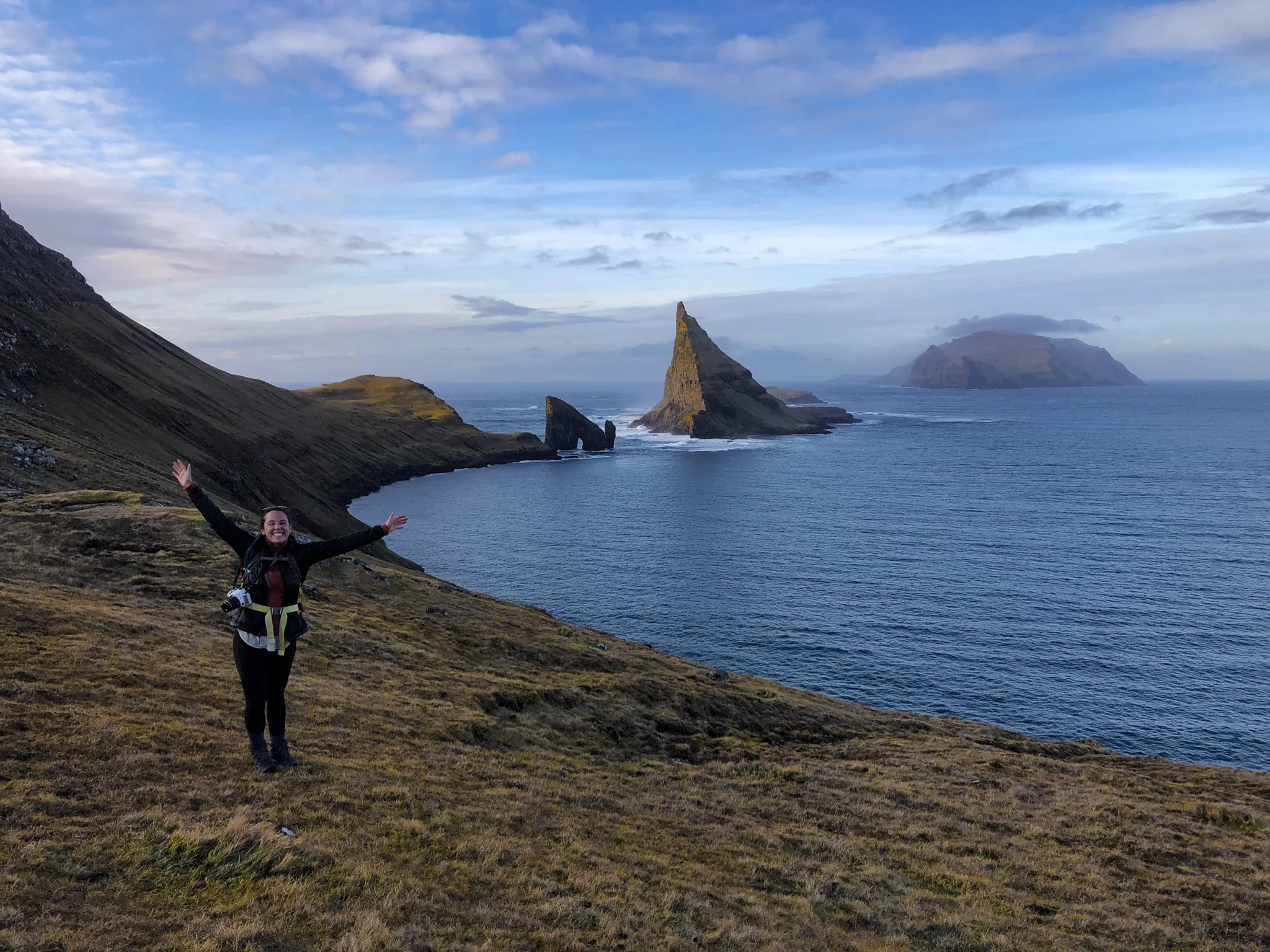
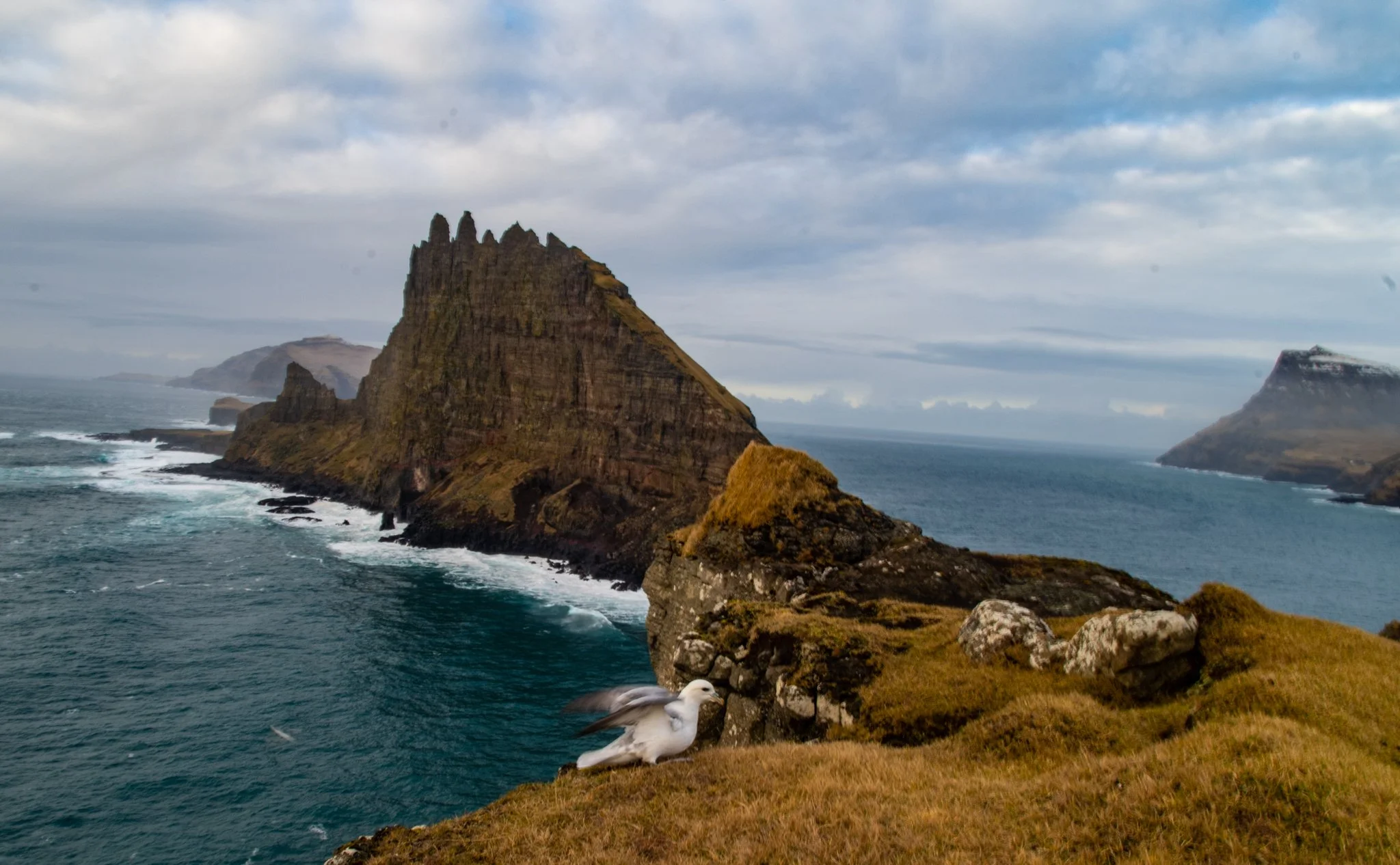
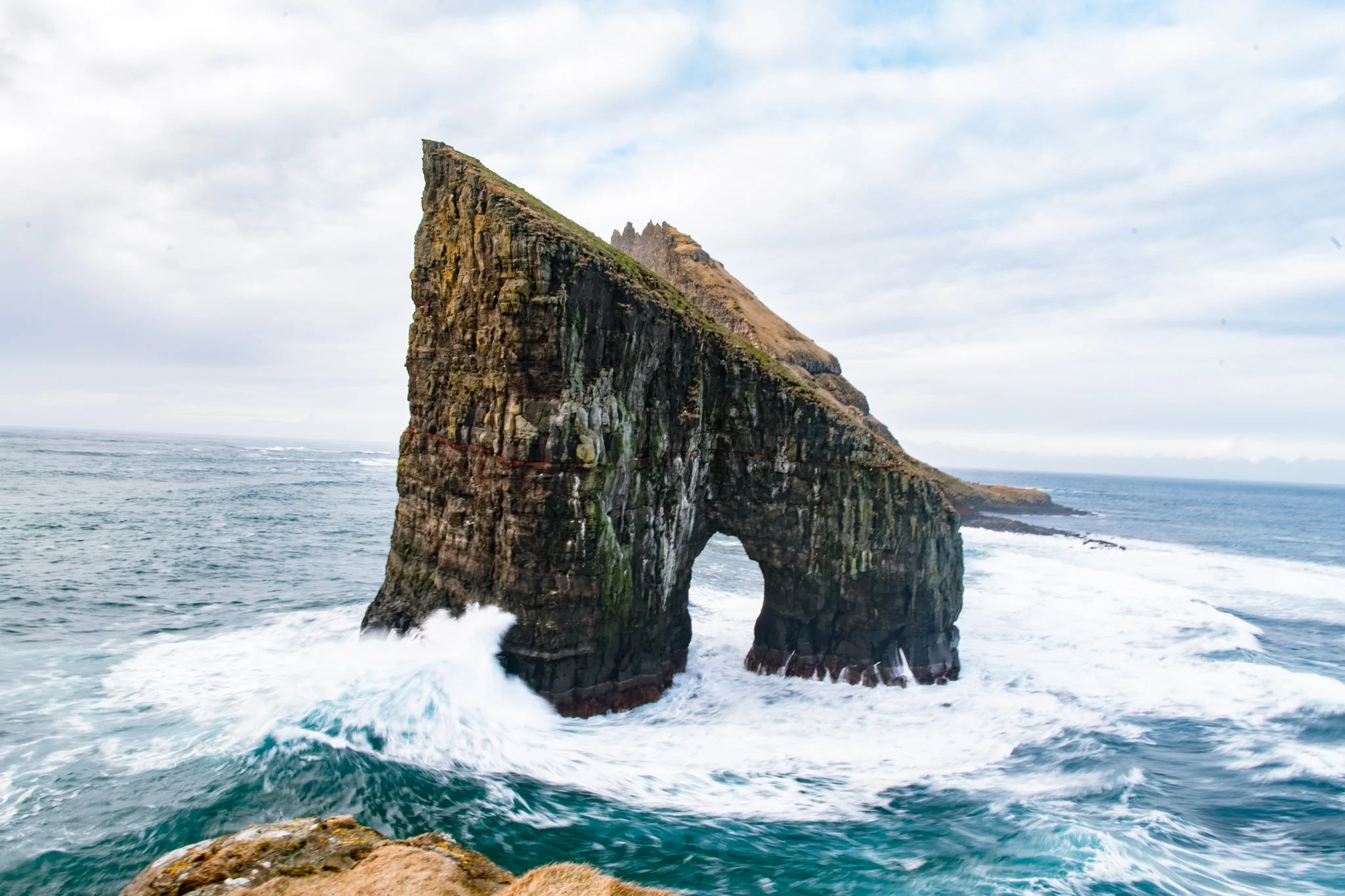
Another ten minutes through the sloping landscape and we rounded a corner. The famous sea stacks we had come to see peakedout on the horizon, Drangarnir. In a country forged by the unforgiving storms and ceaseless waves of the Atlantic, rugged coastlines and monumental sea stacks are not a rarity, but these were by far the most iconic. First, Litle Drangur, or “small sea stack,” an arch, chiseled into a colossal trapezoid. Behind it, Stori Drangur, “large sea stack,” a mountain cut in half, topped with a knuckled ridgeline, an unsettling resemblance to a monstrous sleeping dragon. Their magnitude made my neck prickle.
Another hour of slipping through mud we reached our land’s end, enjoying lunch on the cliffside, watching waves curl against the base of Litle Drangur while gulls dive-bombed from above. Behind us a tremendous cliff semi-circled, its edges blurred by the salty spray from the relentless waves below.
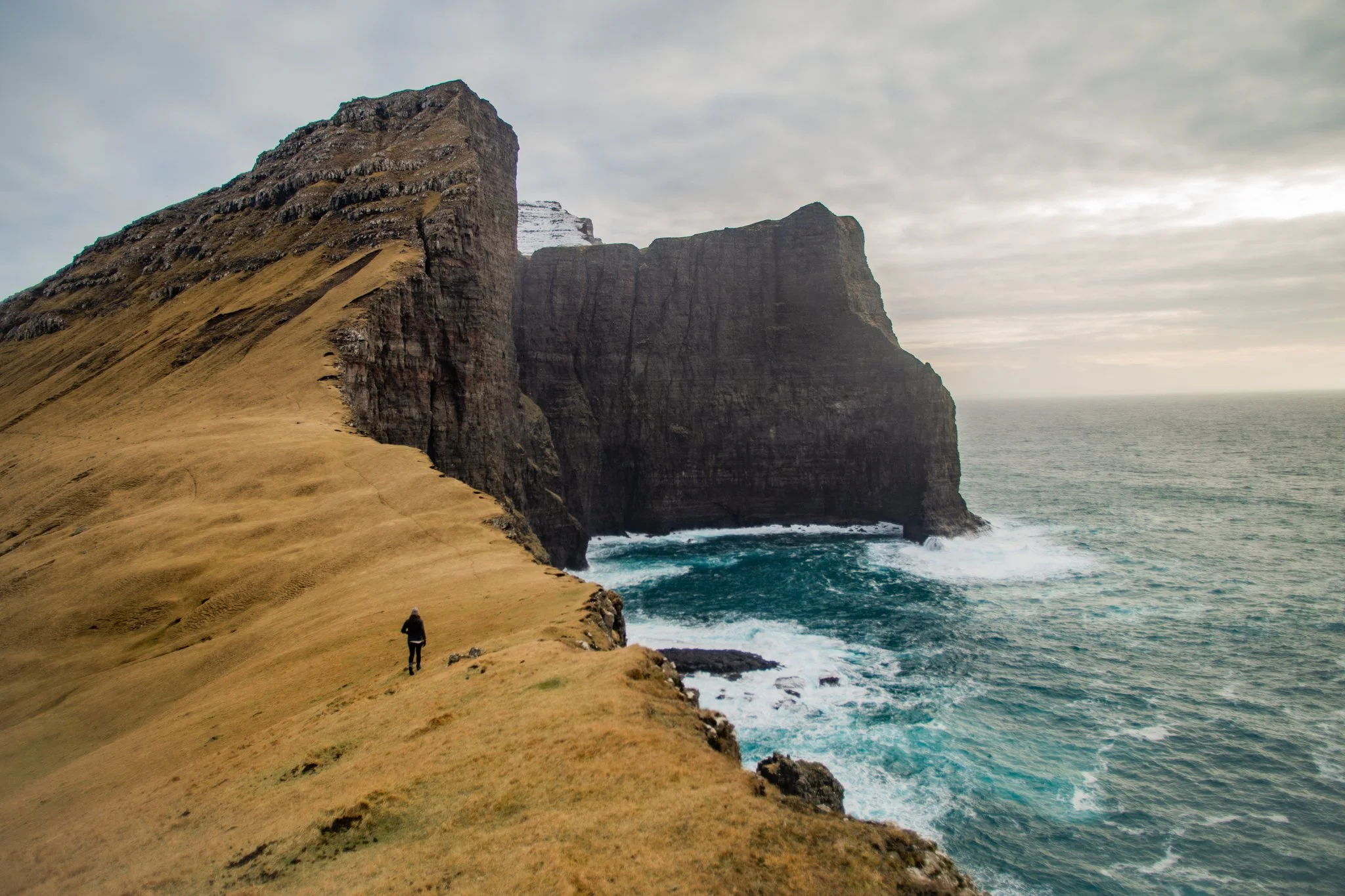
I stood there with wind-bitten cheeks and the same wide smile of the solitary hiker before. I felt miniature in this gargantuan landscape. In reality, this entire country is just a speck halfway between Iceland and Norway, simply words rather than a land mass on most maps. The majority of the world has not heard of this country. And yet here I stood, in the most over-the-top, breathtaking scenery I had ever encountered.
There was something so hopeful in the remoteness of it, the fact that places this wild still exist, 10 minutes from an international airport nonetheless. I couldn’t help but think that if this was America, Dranganir would have a road straight to it, with cement paths and vault toilets. Perhaps a hotel would have sprung up, a covered balcony of overpriced drinks and priceless views, a heated infinity pool. The cliffs would be cordoned off with fencing, to prevent peeking at the churning waters below. Large signs would give information of nesting birds, stories of sunken ships and the formation of these colossal forms. Another sign would request Virdring of the environment, but behind it a plastic bottle or chip bag would be just out of reach. The magic would be lost.
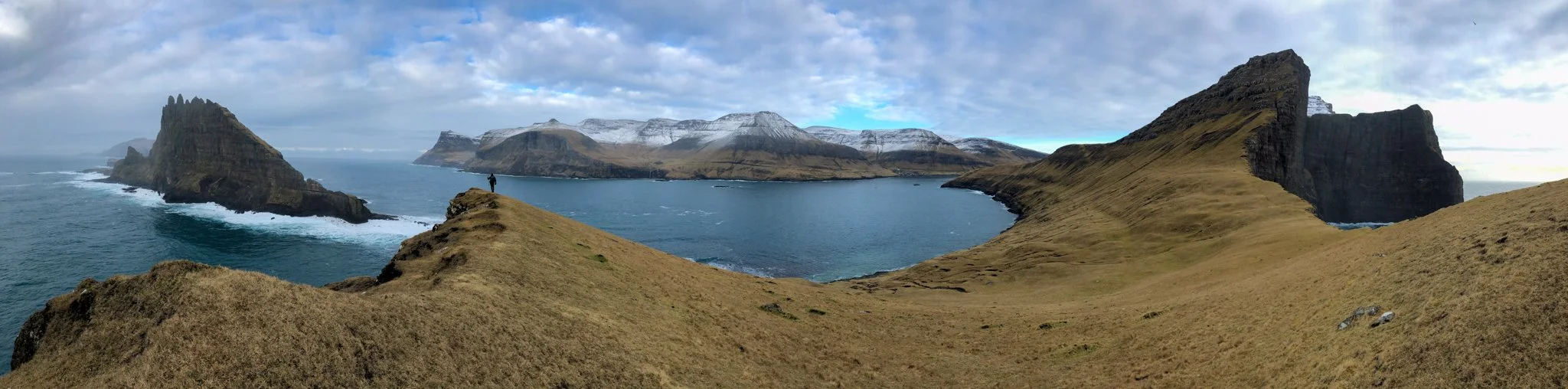
Instead, Dranganir is in the Faroes. It is protected by a farmer and his telescope across the bay. Instead, this is a spot shared only with grazing sheep, tormenting winds, and screaming gulls. Instead, this is a view to be earned.
By paying for the hike to Dranganir, I added a quantifiable value to this invaluable landscape. Though it should be accessible to all, regardless of economic status, those who can afford it should pay without hesitation with the mindset that they are helping to preserve it. Because standing on that wave-battered cliff, listening to the scream of the gulls, feeling the salty air kiss my face- I have rarely felt more alive, and that is priceless
Planning Your Own Hike to Drangarnir
Where: Sørvágur, Vágar Island — about 10 minutes from Vágar Airport, which makes it an easy first or last stop on a Faroe Islands trip.
Access: Drangarnir sits on private land, so it's guide-only — no independent hiking allowed. Official guided tours now run through hiking.fo, Wednesdays, Saturdays, and Sundays between April and October, with set departure times (currently around 10am, 12:30pm, and 2pm). Outside that booking system, some local guides (Saviour Mifsud among them) also run private trips.
Cost: Official guided tours run roughly 550–600 DKK per person (~$80–90 USD). Private/custom trips with an independent guide may vary.
Distance & difficulty: About 7 miles round trip with roughly 1,300 ft of elevation gain — a moderate hike, no technical sections, but exposed, muddy, and cliff-edge in places.
Duration: Plan for 3.5–6 hours depending on pace and whether you add the side trip to the sea stack viewpoint.
Alternative: A short boat tour (around 90 minutes, ~$150 USD) gets you a closer view of the stacks from the water without the hike — a good option if you're short on time or mobility.
What to bring: Food and water (no facilities on the trail), waterproof layers regardless of forecast, and sturdy hiking boots — expect mud and sheep trails the entire way.
Note: Drone flights are prohibited at the site to protect nesting seabirds.